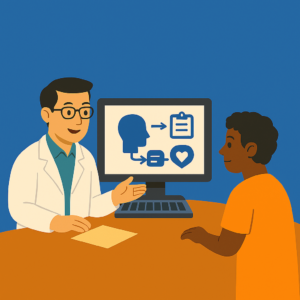
Turning healthcare conversations into structured, explainable care trajectories
Healthcare is fundamentally longitudinal – patients’ conditions, needs, and decisions evolve across repeated consultations and interactions. Yet most health information systems still capture care as isolated visit notes, losing the narrative continuity that clinicians must repeatedly reconstruct. This fragmentation contributes to coordination gaps, documentation burden, and reduced quality of care, particularly for patients with complex needs who see multiple providers over time.
The AURA project develops data science methods that transform healthcare dialogues into computational narratives: structured sequences of clinically meaningful events – actors, actions, goals, emotional shifts, emerging concerns – stitched across multiple sessions into explainable longitudinal trajectories. The project builds robust multi-speaker processing pipelines for real-world clinical audio, LLM-based narrative extraction with factuality verification, and change-point detection methods that identify meaningful shifts in a patient’s care journey. AURA is designed to be domain-adaptive, with the same core pipeline supporting group therapy sessions, one-to-one consultations, and other healthcare settings through context-specific adapters.
AURA is an international collaboration between the SDU Metaverse Lab, the Applied Machine Learning Lab at the University of Bonn, and the Department of Psychology at SDU. The project’s initial focus is on neurodivergent children and youth, and clinical consultations at the SDU Student Clinic.