Leading Europe's advanced digital skills by providing knowledge, guidance, and best practices to shape the digital future

Over the past decade, significant progress has been made in the areas of advanced technologies. This has created challenges where an individual’s level of digital skills influences their successful employment and engagement with society.

During the Covid19 pandemic, European member states made significant progress in their digitalisation efforts. However, Europe (EU) is still struggling to tackle the gaps in digital skills, ensuring access to high-quality digital training and skills for workers and citizens. The data of the 2022 DESI report show that only 54% of Europeans aged between 16-74 have at least basic digital skillsThe digital decade target is at least 80% of citizens by 2030. LeADS, in the context of the Digital Europe Programme, aims to deliver insights into the changing Advanced Digital Skills (ADS)demands within a dynamic technological development context and current digital transformation to equip the education and training communities by providing roadmaps and guidelines.

LeADS activities will ensure that all interventions related to advanced digital skills are in line with gaps present in the market, working closely with industries for the uptake of training, reskilling, and upskilling the workforce and communities.

Project contact: Jacob Nielsen

Project website: https://advancedskills.eu

Research topics: #ADS (Advanced Digital Skills), #ADS Education Mapping #Demand and Supply Mapping #Curriculum Design

Develop teaching materials to prepare the young generations for a digital future

For the economic development of the German-Danish programme area, cross-border use of the growth potential is of crucial importance. A central challenge is the digital transformation of the labor market. The rapid development of digital technologies is leading to an increasing replacement of humans by robots, self-learning and generative AI software  and e-Manufacturing. This goes hand in hand with changes in professions for which innovative educational opportunities are needed to prepare future skilled workers for the necessary competence requirements. However, according to international comparative studies, the education systems at primary and secondary school level in Germany and Denmark are not fully prepared for this. There is therefore an urgent need for action to ensure that school children achieve the basic competences needed to further educate themselves through our education systems and enter the labor market with up-to-date  digital skills.

Project contact: Jacob Nielsen

Project website: https://diasper-project.eu/

#technology education, #STEM / STEAM #computational thinking #digital skills

Using data to make games better

Video games are a global interest, but information about precise behaviours, engagement, and scale is difficult to find. This project aims to bring better information about global gaming engagement directly to video game creators, providing better support for creating and marketing games in addition to improving the sustainability of video games. We are producing a website to host information about player behaviours on a global scale with an unprecedented scope.  

Project contact: Anders Drachen and Christine Tomlinson

Research topics: #game analytics #sustainable games #global gaming #player behaviours 

  1. Zendle, D., Flick, C., Halgarth, D., Ballou, N., Demediuk S. and Drachen, A. (2023): Cross-cultural patterns in mobile playtime: an analysis of 118 billion hours of human data. Nature Scientific Reports (13), 386. https://doi.org/10.1038/s41598-022-26730-w
  2. Zendle, D., Flick, C., Gordon-Petrovskaya, E., Ballou, N. Xiao, L. Y. & Drachen, A. (2023): No Evidence that Chinese playtime mandates reduced heavy gaming in one segment of the video games industry. Nature Human Behavior.  https://doi.org/10.1038/s41562-023-01669-8
  3. Zendle, D., Flick C., Deterding, S., Cutting, J., Gordon-Petrovskaya, E., Drachen, A. (2023): The Many Faces of Monetisation: Understanding the Diversity and Extremity of Player Spending in Mobile Games via Massive-scale Transactional Analysis. ACM Games 1, 1, Article 4 (March 2023). https://doi.org/10.1145/3582927
  4. Zendle, D., Flick C., Deterding, S., Cutting, J., Gordon-Petrovskaya, E., Drachen, A. (2023): The relationship between lockdowns and video game playtime: A multilevel time-series analysis using massive-scale data telemetry. Journal of Medical Internet Research (forthcoming). http://dx.doi.org/10.2196/40190

Experience Real-World Training in a Virtual World – The Best of Both Realities

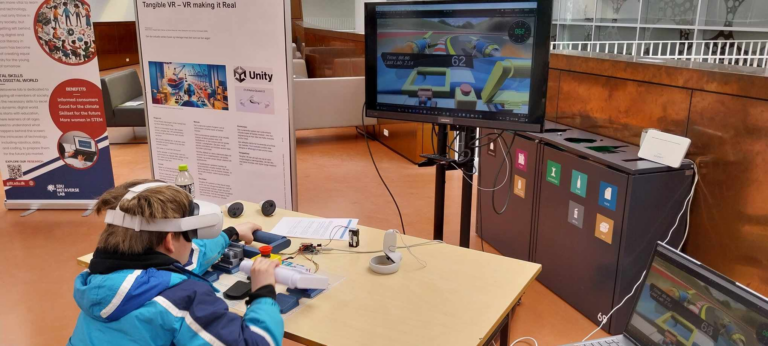
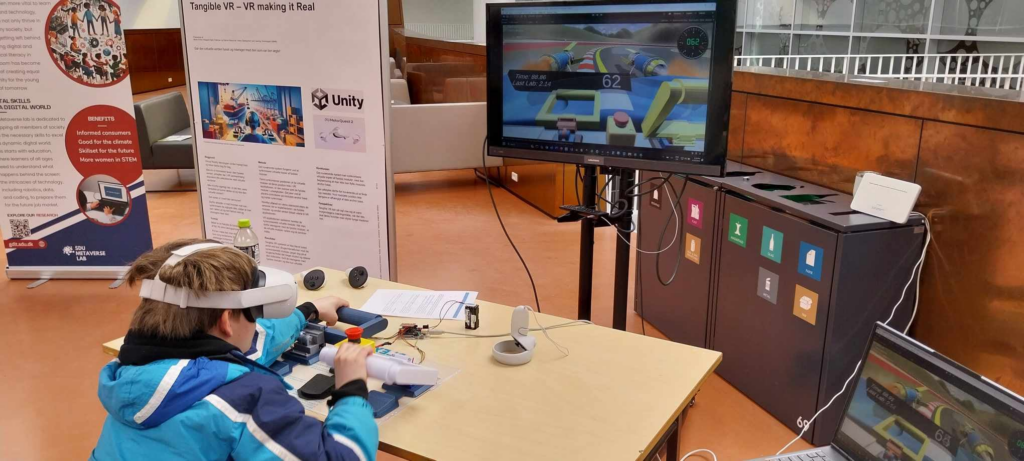
A boy driving a podracer created with the Tangible VR system.

In the realm of virtual reality (VR) training, Tangible VR stands out as a groundbreaking project that bridges the gap between digital simulations and physical interaction. This innovative approach integrates real physical structures—like buttons, handles, and tables—into the VR environment. The key to this integration is the combination of advanced hand tracking technology, real/virtual world synchronization and microcontroller technology providing sensor feedback.

Tangible VR thereby transforms the training experience, allowing the user to interact with physical elements while fully immersed inside a virtual world.

Traditional VR training often relies on controllers, or hand-tracking while users wave their hands in thin air, limiting the naturalness and intuitiveness of interactions. By contrast, Tangible VR offers a more immersive and realistic experience, making it ideal for skills development in various fields, such as production industries and industries involving heavy machinery.

Trainees can manipulate actual objects, enhancing muscle memory and spatial awareness in a way that traditional VR cannot match. Moreover, Tangible VR combines the flexibility and safety of a virtual environment with the tactile feedback of real-world objects. This dual approach allows for a broader range of training scenarios, from routine crane operations to high-risk maneuver training, without the associated real-world risks or costs.

It represents a significant step forward in VR training, promising more effective learning outcomes and a deeper level of engagement for users.

A modular and scalable approach to Tangible VR application development.

The project has developed a new Unity development system, which automatically handles the synchronization process and auto-generates the necessary microcontroller code, based on user input (e.g. which types of sensors they prefer to use, and which objects should be synchronizable).

The only requirement is that  users possess both a physical and virtual object – making it ideal for 3D design and printing.

An overview of the system and its innerworkings can be viewed in the following article (published at HCII, 2024), and the system is freely available from the following link:

*The system may not be used for any military purposes and or applications.
**Version 2.0.0 which is made for the new META SDK, will be released in mid July – stay tuned.


Example: Robotic Arm (Tangible VR - Development System, v1.0.0).

The video below demonstrates how a simple robotics arm can be synchronized, using only a simple microcontroller and three potentiometers (rotation sensors).

Example: LEGO Go-Cart Steering Wheel (Tangible VR - Development System, v1.0.0).

The video below demonstrates the synchronization of a LEGO steering wheel.

The LEGO model was first designed using the 3D tool Meca Bricks, then assembled in real life and equipped with a potentiometer to detect the steering wheel rotation and two push-buttons to detect the speeder and brake inputs.

Example: POD-racing (Tangible VR - Development System, v1.0.0).

The image below, is from a POD-racer project, in which two tangible handles have been 3D modelled using Blender, then 3D printed and outfitted with a potentiometer to detect their angular positions.

In addition, an emergency push-button were taken from stock and 3D modelled in Blender.

The components were then registered as synchronizable in the development system and placed inside a POD-racer modelled for the game.

This allowed kids at an open-day at the University of Southern Denmark, to visit and race around in an “actual” POD-racer, which they could both see and touch.

Project contact: Patricia Lyk and Bjarke Pedersen

Research topics: #Augmented Virtuality #Augmented Reality #VR #AR #simulation #haptic feedback #training #skill development #cyber-physical systems #virtual reality training

Alleviating Boredom and Anxiety from the Patient Experience

CARES focuses on the major societal challenge we have around in-hospital patients that suffer from anxiety, boredom and social isolation. This is especially pronounced for children in in-hospital care. Hospitals have very few resources to deal with this, and as a result, in-unit care times are increased and overall patient well-being is reduced and cost per patient goes up. There is substantial amounts of research that shows that alleviating anxiety, boredom and social isolation has massive benefits, but we lack knowledge about how to do this, and notably how to do this in a sustainable way given the current practical situation in hospitals. The SDU Metaverse Lab addresses this challenge through the application of digital media (AR/VR combined with game technologies) in hospitals, with a full lifecycle approach – i.e., not only doing the research to develop technology and applications but also making the implementation of the resulting solutions into hospital environments and the sustainable, practical long-term use and maintenance of these systems a part of our work. CARES represents spearhead R&D challenge for SDU Metaverse Lab.  

Project contact: Anders Drachen

Research topics: #patient experience #wellbeing #anxiety #isolation #boredom #games #artificial intelligence #VR #AR #XR

Shaping Ethical and Sustainable Monetization in Gaming for a Fairer Digital Economy

The SARMI (Sustainable and Responsible Monetization in the Video Game Industry) project addresses critical challenges in the rapidly growing $200bn global games industry. With over 4 billion gamers worldwide, the sector not only forms a significant part of the economy but also profoundly impacts cultural and social landscapes. The Danish games sector, generating over 1.3bn DKK annually, epitomizes this growth, particularly among young demographics.

At the heart of SARMI lies a crucial concern: the ethics and sustainability of monetization strategies in video games. Current practices, ranging from selling virtual items to the use of digital currencies, have sparked public, media, and regulatory debates over their potential predatory nature. This is especially critical for Small and Medium-sized Enterprises (SMEs) in the Creative Industries, pressured to adopt such models for economic survival.

Unlike the music and film sectors, the video game industry suffers from a lack of comprehensive data and transparency, leading to outdated academic research and policy-making challenges. SARMI’s fourfold objectives aim to remedy this:

  1. Evidence Building: Utilizing petabyte-scale industry data, SARMI will create a first-of-its-kind overview of digital economies in games.
  2. Defining Responsible Monetization: Establishing a consensus on what constitutes responsible monetization in games, leading to practical recommendations for the industry and policy-making.
  3. Predictive Modeling: Developing models to help companies identify sustainable and responsible monetization strategies.
  4. Industry Implementation: Integrating findings into industry analytics tools, directly influencing new game development.

Thanks to collaborations with industry partners, SARMI offers an unprecedented opportunity to influence a vast array of games and developers. SARMI extends beyond games, potentially shaping monetization practices in the broader “creator economy.” Its outcomes will provide the first reliable assessment of the gaming industry’s monetization strategies and practical pathways toward ethical revenue generation, benefiting researchers, industry professionals, and policymakers.

Project contact: Anders Drachen

Research topics: #Monetization #Game Development #Microtransactions #Creative Industries #Video Games #Economics #Online Economics #Sustainability #Big Data #Responsibility

Data-driven technology effects research for societal benefit​

Billions of people play games, use social media, and engage with other digital technology every day. When we interact with such technology, we leave behind traces in the form of data. This provides a unique source of insight into human activity and behaviour at an enormous scale. The Digital Observatory Research Cluster (DORC) is an international research network that leverages this data for socially beneficial research. We help stakeholders access and analyse large-scale datasets from and around digital technology, and fuse this data with information on behaviour, culture, wellbeing, economics and more.

Project contact: Anders Drachen

Research topics: #data science #artificial intelligence #game analytics #digital economies

Et erfaringsskabende pilotprojekt

MYRE Syddanmark  er pr. maj 2026 flyttet til det nye MYRE-univers: myre.tech 

Across borders

In MYRE, there are naturally also international aspects. Technologies and their influence on our lives do not stop at the borders. Everywhere, there is a search for modes and methods to organize education and teaching in relation to the possibilities and challenges that technologies bring with them.

Innovative educational practitioners may have found convincing local solutions that may not be directly transferable, but can contribute with inspiration for further development other places.

European reports and policies support this approach. Exchange across country borders, as well as research and transnational co-creation is promoted by the European Union, OECD, UNESCO and other major influential bodies.  

Berlin, April 2024: Danish and German MYRE teachers  and students coordinated for their joint information stand “Across borders – digital education” at Forum  Bildung Digitalisierung. The students presented their first learning products: avatars with AI, robots with sensors, poster documentation with AR, a 3D-printet water power plant, and learning videos. 

Denmark-Germany

During spring 2023, bilateral dialogues between educational organizations from Funen in Southern Denmark, from Berlin and from the Northern German state Schleswig-Holstein, led to findings about specific interests, regarding the didactic and pedagogical work with emerging technologies. A partnership was formed, and a joint project was designed. 

MYRE DK-DE could start in January 2024 as a practical preparation in collaboration for initiating a major Danish-German project. This largescale project MYREcross has been applied for in January 2025 and is intended to start end 2025. 

With gratitude to Interreg Deutschland-Danmark

MYRE DK-DE (2024): in short

MYRE DK-DE (More Youths Realize Emerging Technologies) addressed challenges from emerging technologies, such as Artificial Intelligence, robotics, and the Metaverse, as well as lesser-known technologies like Quantum Computing. These technologies have a global impact but pose local challenges, often addressed by ad-hoc local initiatives.

The project focused on equipping educational institutions and enhancing student learning by managing the threats and opportunities these technologies present.

MYRE DK-DE involved Svendborg Erhvervsgymnasier as the lead partner, The University of Southern Denmark (SDU), and RBZ Wirtschaft . Kiel. The partners worked in local consortia in each their “education chain”: from lower to upper secondary and further education. 

All together, the partners aimed for a more systematic approach by mutually peer-reviewing and collaborating on local solutions.

While at least 10 teaching modules had been intended to be developed, reviewed, and refined in exchanges across the border, the project ended up with 13 modules.

Evaluation covered local implementation, student learning impact, and teacher empowerment. The ROBOdidactics model served as a common framework.

The project was organized into five work packages: 1) Project management, 2) Quality & evaluations, 3) Exchanges & collaboration, 4) Production, and 5) Documentation & follow-up. 

MYRE DK-DE emphasized transparency and co-creation across educational levels. The project aimed to ease career choices for young people and their educational transition. 

The project became the spearhead for a broader Danish-German initiative. This initiative resulted in the groundwork for a formal network and for a series of MOOCs (massive open online courses) for border-crossing empowerment and collaboration.

Additional educational partners and their local consortia were committed in Schleswig-Holstein and Southern Denmark, respectively.

Didactic principles

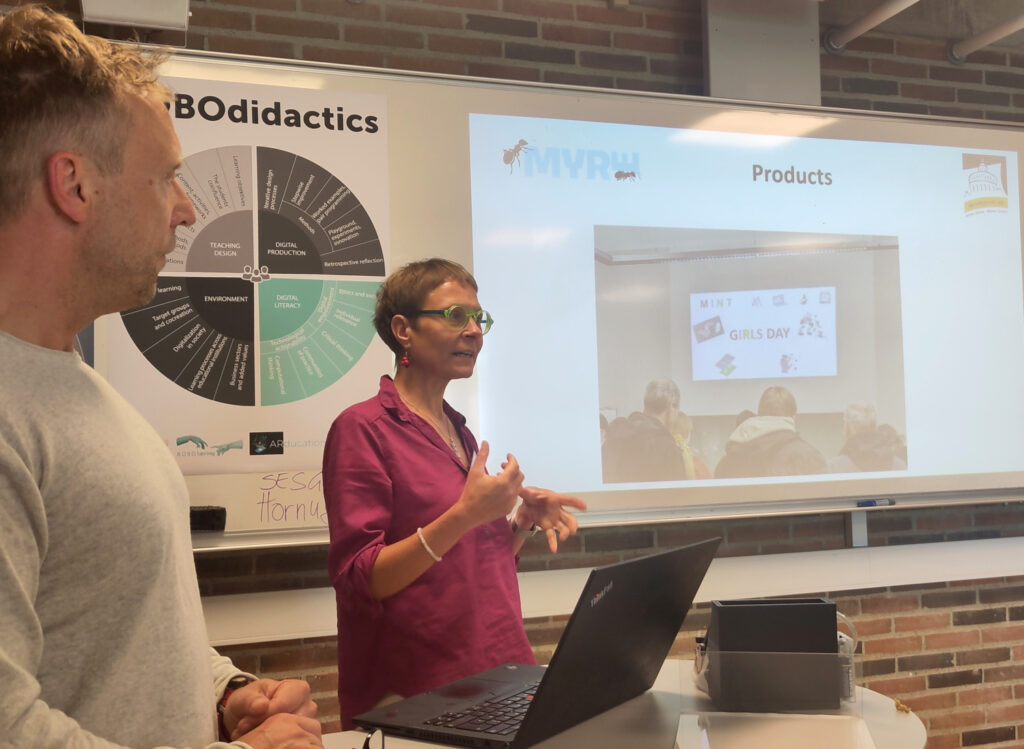
The tech-didactic model ROBOdidactics (Majgaard 2019, vs. 2.0 2020) served as a joint framework for mutual understanding and development or further development of local teaching processes. 

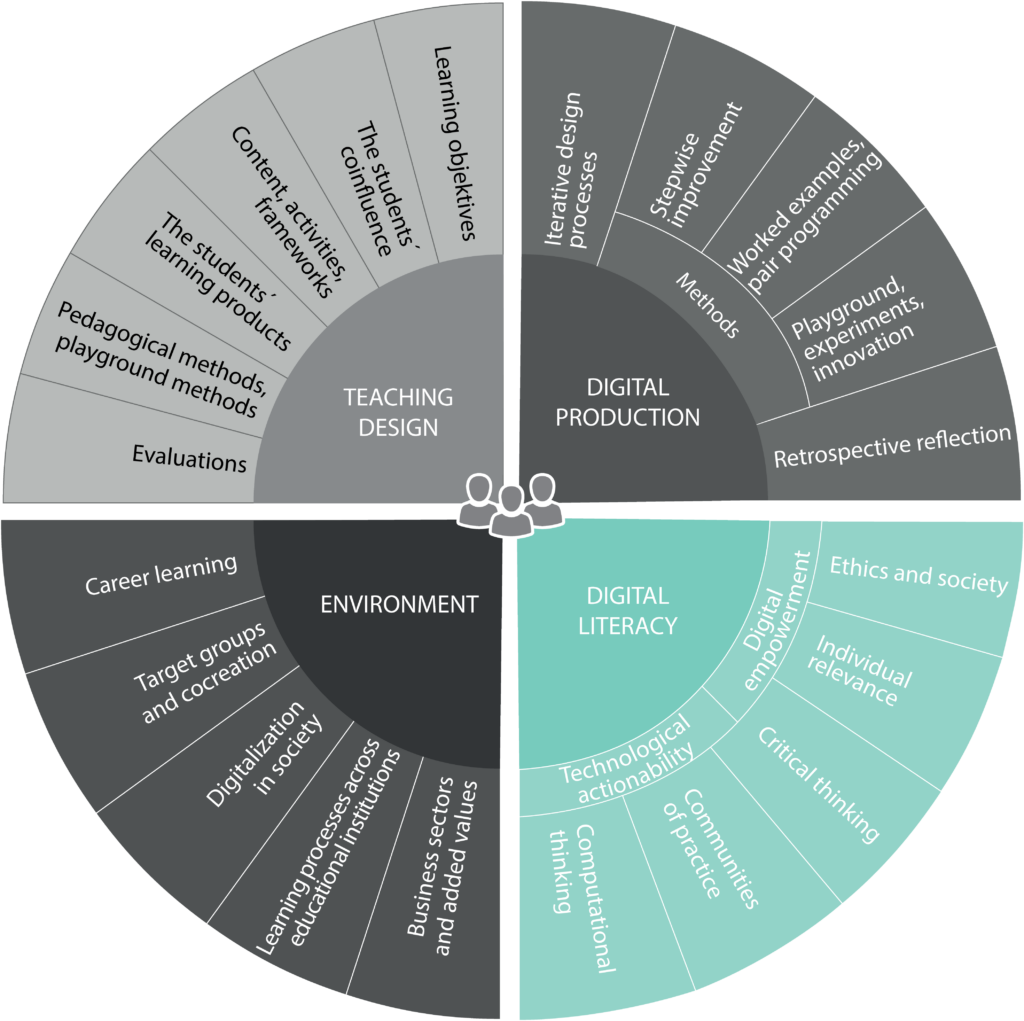
The teaching modules were applied in the educational programs according to the respective regulations, as well as adapted for co-teaching across the levels. The modules promoted the students’ digital production, digital literacy, and career learning, while incorporating activities related to sustainability (UN Goals) and border-crossing themes.

As one of the key outputs from MYRE DK-DE, a necessary update of ROBOdidactics was undertaken. A comprehensive cross-border work process resulted in DigiDidactics (Nov. 2024), which will serve as a framework for the future tech-didactic teaching modules.

Quality, evaluations, and final report

MYRE DK-DE focused on the quality of both deliveries and the work process.
A coherent and operational quality concept has been applied, featuring quantitative and qualitative methods for formative evaluations of:
– Student learning processes and their learning products,
– Teacher competencies,
– Consistency and applicability of the didactic methods.

All these aspects have been practised and represented in the teaching modules, which are systematically described and published.  

The University of Southern Denmark (SDU) has ensured the quality of these didactic processes. The development of the teaching modules was closely monitored, with ongoing professional feedback provided to participants.

At the same time, a critical distance was maintained to enable research-based conclusions on the broader application of emerging technologies in education.

Fremtidsteknologier for sproglæring i EUD

MYRE midt er pr. maj 2026 flyttet til det nye MYRE-univers: myre.tech

Tak til

Kontakt projektledelsen